
Why well-being at the office is more than just ergonomics
When companies invest in well-being at the office, the focus is often on ergonomic measures. Think of ergonomic office chairs, sit-stand desks, properly adjusted screens, and training on healthy work posture. These investments are important and form the basis of a comfortable and safe working environment.
However, it turns out in practice that ergonomics alone is not always enough to prevent physical complaints. Many employees spend seven to nine hours a day at their desks. Even when their workspace is perfectly arranged, they often remain in the same position for long periods. And therein lies a significant challenge.
The human body is not designed to sit still for hours on end. Our muscles, joints, and spine function optimally when they move regularly. Prolonged sitting can lead to tension in the back, neck, and shoulders, reduced muscle activity, and decreased blood circulation. Over time, these factors can contribute to fatigue, discomfort, and even chronic complaints.
That is why the focus within modern ergonomics is increasingly shifting from just support to support and movement. The question is no longer just whether an employee is sitting correctly, but also whether he or she is moving enough during the workday.
A healthy workplace combines both elements. On the one hand, it provides the necessary ergonomic support, on the other hand, it encourages employees to regularly change their posture and stay active. Because the best sitting posture is ultimately not one perfect position, but a position that constantly varies.
Active sitting plays an important role in this. By allowing natural micro-movements of the core muscles while sitting, the body remains active without employees having to interrupt their work. This way, movement becomes a natural part of the workday again and ergonomics contributes not only to comfort but also to the overall well-being in the office.
Well-being in the office is higher on the agenda today than ever. Organizations are investing in ergonomic workplaces, prevention of back complaints, mental health, and sustainable employability. Yet, one important factor is often underestimated: the amount of time employees spend sitting each day.
Active sitting as part of ergonomics in the workplace
Organizations are increasingly looking at ergonomics from a broader perspective today. In addition to preventing physical complaints, there is also growing attention to factors such as comfort, concentration, job satisfaction, and sustainable employability. The workplace is no longer seen solely as a place where employees perform their tasks, but also as an environment that supports their health and performance.
For this reason, many companies invest in solutions that help employees work healthier and more comfortably. Sit-stand desks, ergonomic workplace analyses, and awareness campaigns around posture and movement are increasingly becoming part of a integrated wellness policy.
Binnen die evolutie groeit ook de belangstelling voor actief zitten. Waar traditionele bureaustoelen vooral ontworpen zijn om ondersteuning te bieden, richt actief zitten zich op het stimuleren van natuurlijke beweging tijdens de werkdag. Medewerkers hoeven hiervoor hun werk niet te onderbreken of extra tijd vrij te maken. Beweging wordt een vanzelfsprekend onderdeel van het dagelijkse werkproces.
This approach aligns with the way many organizations today view prevention. Instead of addressing complaints when they arise, there is a growing focus on creating a work environment that supports healthy behavior. By combining ergonomics with movement, a workplace is created that is not only comfortable but also contributes to the long-term well-being of employees.
Active sitting thus forms a valuable addition to the modern office environment. It supports the ambition of organizations to keep employees not only productive but also healthy, energetic, and sustainably employable.
Wilt u weten hoe actief zitten kan bijdragen aan een gezondere werkplek?
Ontdek hoe SpinaliS beweging integreert in de werkdag.
Make an appointmentHow SpinaliS supports active sitting
Active sitting requires a workplace that does not restrict movement but rather supports it. That is the difference between a traditional office chair and a SpinaliS chair.
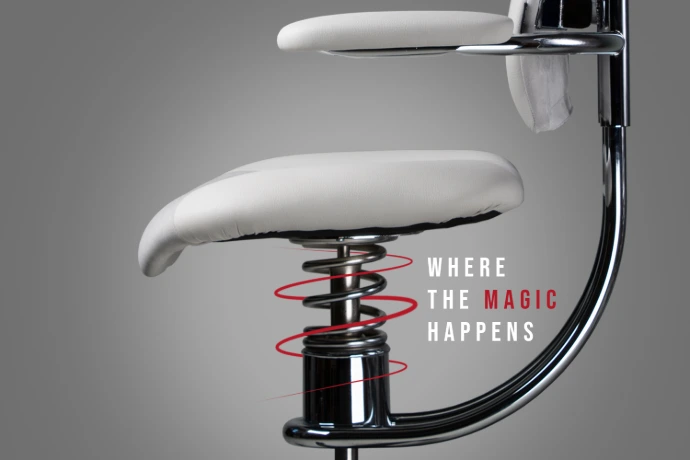
While many office chairs are designed to keep the user as stable as possible, SpinaliS starts from a different vision. The unique, dynamic seat moves with the body and stimulates natural micro-movements while sitting. This keeps the body active without requiring extra effort or distracting from daily tasks.
While working, the back, abdominal, and core muscles continuously make small adjustments to maintain balance. These subtle muscle activity ensures that the body does not quickly adopt a passive posture and helps to prevent slumping of the back.
For employees, this means a more dynamic way of sitting that better aligns with the body's natural need to move. For organizations, it offers a practical way to integrate movement into the workday without changing processes or requiring additional time investments from employees.
SpinaliS thus combines two important pillars of a healthy workplace: ergonomic support and active movement. The result is a seating solution that not only provides comfort but also contributes to a modern vision of well-being in the office and ergonomics in the workplace.
By making movement a natural part of sitting, SpinaliS supports organizations in their pursuit of healthier, more comfortable, and future-oriented workplaces.
Conclusion
A healthy workplace today is about more than just a properly adjusted office chair or an ergonomically designed workstation. While ergonomics forms an important foundation, there is a growing awareness that prolonged sitting is one of the biggest challenges in modern office environments.
Organizations that invest in office wellness are increasingly looking beyond traditional ergonomic solutions. They are seeking ways to integrate movement naturally into the workday, without compromising comfort or productivity.
Active sitting fits perfectly with this evolution. By subtly keeping employees in motion while working, a more dynamic way of sitting is created that better aligns with the body's natural needs. This not only contributes to more comfort but also supports a healthy and sustainable work environment.
With its unique dynamic seat, SpinaliS combines ergonomic support with natural movement. This helps SpinaliS organizations elevate ergonomics in the workplace and actively contribute to the well-being of their employees.
Because the workplace of the future is not just about sitting well, but especially about staying active.